
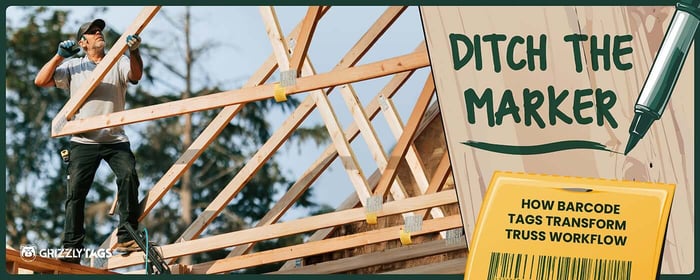
Ditch the Marker: How Barcode Tags Transform Truss Workflow
Table of Contents
Picture this: It’s a busy morning at your truss plant, stacks of trusses are waiting to be staged, crews are scrambling through handwritten notes, and a delivery truck is waiting while someone hunts for the right bundle. In the middle of the chaos, an installer calls to say they can’t tell which truss belongs where — the handwritten notes have smudged with sawdust and rain. Sound familiar?
For decades, handwriting on trusses has been the norm, and dealing with that familiar chaos is "how we’ve always done it." What seems like a simple, low-cost solution actually fuels costly errors, delays, and inefficiencies across production, delivery, and installation, in an era where precision, speed, and traceability drive profitability, relying on handwritten markers and memory is holding the truss industry back.
The construction industry is increasingly turning toward automation and digital workflows, and printed barcodes and tagging systems have emerged as one of the most effective ways to streamline truss manufacturing. This modern solution can integrate seamlessly with an existing ERP system, connecting physical products to accurate digital data that reduces human error and increases efficiency from plant to job site.
The Problem with Pen and Marker
It may seem trivial: a crew uses a marker to write “Gable A-3, Job 1234” on a truss web. But while this method is simple, it introduces a range of costly inefficiencies:
- Human error: Even the most careful worker can misread or miswrite a number, leading to misplaced trusses or incorrect installations.
- Illegibility: Handwritten markings fade, smear, or get damaged during handling, storage, or transport.
- Inconsistency: Different handwriting styles and abbreviations can make standardization difficult across shifts or crews.
- Lost data: Once a marking fades, so does your traceability. There’s no way to confirm production timing, materials, or job origin.
Multiply those small errors by hundreds or thousands of trusses a week, and the costs add up fast.
Don’t just take our word for it. A 2022 industry survey conducted by Autdesk and FMI showed that poor data and communication were responsible for 48% of all reworked projects in the U.S. alone. Globally, that bad data cost the construction industry over $1.84 trillion in 2020. Much of that loss comes from inconsistent, incomplete, or inaccessible information — exactly what handwritten labeling creates. In short, poor labeling equals bad data, and bad data equals money out of your pocket.
The Barcode Advantage
The cost of errors caused by handwritten labels is obvious, but the solution is even clearer. By assigning a unique barcode or QR code to each truss, manufacturers create a reliable digital trail of every truss that tracks every component from fabrication to the job site. The result is faster processing, fewer mistakes, and measurable gains in shop floor efficiency.
Consistency and Clarity Every Time
Printed tags are always legible — no smudges, no guessing. They can display critical information such as job number, truss ID, pitch, plate layout, and placement sequence. When printed on our durable stock truss tags, your data remains readable through moisture, sunlight, and rough handling.
Accuracy That Outperforms Handwriting
Truss tagging systems enable manufacturers to include sequencing data, such as “Job A | Position 5 | Left Gable,” to automate loading and installation orders. Add a barcode, and a simple scan instantly verifies the correct truss, ensuring builders receive exactly what was ordered. Studies from Zebra Technologies show barcode systems reduce data-entry errors to just 1 in 3 million, compared to 1 in 300 for manual input.
Faster Workflow from Plant to Site
Scanning a truss barcode takes seconds. This is far faster than searching through handwritten stacks or verifying orders manually, saving valuable labor time and minimizing costly shipping mix-ups. In high-volume plants, that time savings compounds fast.
End-to-End Traceability
Barcoding provides a digital footprint for every truss. Every stage of production — from pressing to QC to shipping — can be logged through barcode scans. Scanned data can be logged into your plant’s ERP or job management software, offering instant visibility into which orders are completed, in transit, or installed. If an issue arises, manufacturers can use this data to trace exactly where the process faltered.
Professional Presentation
Want to add a touch of brand recognition and professionalism? We can customize your tags with your logo and contact information. Builders, inspectors, and end customers will notice the difference when trusses arrive clearly labeled — reinforcing your reputation for quality and organization.
ERP Integration Made Easy
One of the most powerful features of a printed tagging system is how easily it connects with your existing ERP (Enterprise Resource Planning) software.
Here’s how it works:
- Your ERP already holds your data — such as job numbers, truss configurations, and delivery details.
- That data is then sent to one of our heavy-duty industrial printers to automatically populate the printed information, ensuring every tag is accurate and up to date.
- When a truss is scanned on the production floor or at delivery, the ERP updates in real time, confirming job completion, shipment, or installation.
This automation eliminates redundant data entry while creating a live record of production status. The result: fewer mistakes, faster communication, and a stronger connection between your digital and physical operations.
Barcode Tagging in Action
Let’s take our earlier-mentioned truss plant as an example. Previously, the crew wrote job numbers by hand on each truss chord. When several jobs overlapped, confusion was inevitable — mislabeled trusses ended up in the wrong stacks, causing delays and costly rework.
After implementing a barcoded tagging system integrated with their ERP, the workflow changed completely:
- Operators print job-specific tags automatically as each batch is produced.
- Each truss receives a barcoded tag linked to its unique job number.
- As trusses move to staging, workers scan each tag to confirm order accuracy.
- Shipping teams scan trusses at loading, and the ERP automatically updates the job’s delivery status.
This real-time verification ensures every truss reaches the right site, every time. The plant also gains accurate production metrics, helping management identify slow points and plan capacity more efficiently.
Sustainability and Waste Reduction
Beyond speed and accuracy, barcoding also supports sustainability. By reducing rework and misdeliveries, plants cut wasted materials, transportation, and labor hours. Tags themselves can be printed in batches on demand, minimizing surplus inventory.
The Construction Industry Institute reports that up to 30% of construction costs stem from inefficiencies like rework, miscommunication, and material waste. Barcoding helps directly reduce these losses by ensuring accuracy from the very first step.
Durable by Design
In truss manufacturing, tags must endure rough handling, weather, and long outdoor storage. That’s why GrizzlyTags’ truss tags are engineered for these exact conditions. Our stock truss tags, made from high-density polyethylene (HDPE) film, are the same durable materials used for our rebar and lumber customers — tested to resist moisture, UV light, and tearing. These tags remain legible long after ink-based markings have faded or washed away.
Need something more specific? GrizzlyTags also offers custom truss tag solutions tailored to your plant’s workflow. Whether you need short-run custom tags or high-volume stock labels, GrizzlyTags ensures consistency and performance you can rely on!
Grizzly Truss Tags: 4 in W x 5 in L, Matte TT Yellow Film, Rolls, 8 in OD, 3 in Core, Black Mark Sensor, 1200 Tags/Roll, 4 Rolls/Case, 1 Case (4800 Tags), NO RIBBON
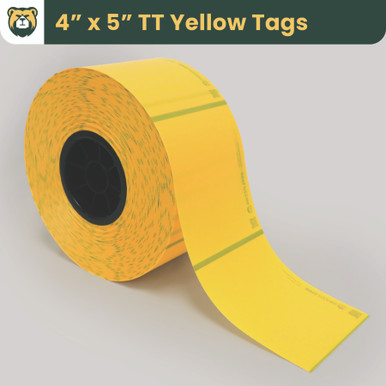
$175.00
Grizzly Truss Tags are engineered for reliable identification and tracking of wood, lumber, and trusses. Perfect for lumber yards and job sites, these tags withstand...… read more
FAQs
How long does it take to switch from handwritten labels to barcode truss tags?
Most truss plants can transition to barcode tagging in a few weeks. Implementation typically begins by synchronizing tag templates with ERP data and training staff to print and scan without disrupting daily production.
What type of barcode works best for truss identification?
Both barcodes and QR codes are effective. Standard barcodes allow fast scanning during production, while QR codes can hold extra details like truss layouts, sequencing, or customer order data.
What equipment do I need to start printing barcode truss tags?
You’ll need a compatible industrial printer, labeling software (or ERP integration), and durable tag stock. GrizzlyTags provides complete solutions — from tag materials to setup support.
Can barcode systems track components or subassemblies before trusses are completed?
Yes! Barcode tags can identify plate batches, subassemblies, and lumber components before final assembly, improving accuracy and reducing fabrication errors.
Is barcode tagging cost-effective for smaller truss manufacturers?
Absolutely! Even small truss shops benefit from fewer labeling errors, faster loading, and reduced rework. Barcoding systems scale easily as production grows, offering quick ROI.
What ROI can truss plants expect from barcode tagging systems?
Barcode truss tags improve accuracy, reduce labor costs, and eliminate rework. Many manufacturers recover their initial investment within a few months of implementation.
Can barcode tagging integrate with our existing ERP system?
Yes! Barcode systems can pull job and truss data directly from your ERP, eliminating double entry. Integration uses templates or exports that fit your current workflow — no costly software overhaul needed.
How customizable are printed barcode truss tags?
Barcode truss tags can include job numbers, sequencing data, customer names, barcodes, QR codes, and color-coding — all automatically filled from your ERP for consistent accuracy.
Can barcode systems run without a network or Wi-Fi connection?
Yes! Barcode scanners can store data offline and automatically sync once reconnected, ensuring continuous operation even in low-connectivity environments.
How do barcode systems improve scheduling, inspections, and compliance tracking?
Every scan logs real-time progress, helping managers plan production and deliveries more efficiently. Barcoded tags also digitize QC records and compliance documentation for easier audits and warranty verification.
What mistakes should truss plants avoid when implementing barcode tagging?
Common mistakes include mismatched ERP data, poor tag placement, and using non-durable materials. Working with an experienced provider like GrizzlyTags helps avoid these pitfalls.
How does barcode tagging prepare manufacturers for future digital integration?
Barcode tagging creates the foundation for smart manufacturing. It supports IoT tracking, AI-based analytics, and automated data collection — future-proofing your truss plant’s operations.
How can my truss plant get started with barcode tagging?
Getting started is simple. Contact GrizzlyTags for a consultation on choosing the right materials, printers, and setup process for your specific ERP workflow and production environment!
It’s Time to Leave Handwriting Behind
Handwritten markings once worked — but as manufacturing technology advances, that old habit is quietly holding operations back. Digital tracking has become the new standard for truss identification because it replaces guesswork with data you can trust.
GrizzlyTags makes the transition effortless. Our truss tags are designed for the demands of the truss industry and integrate seamlessly with your existing ERP — providing every component with a clear, scannable identity from production to delivery. No extra steps, no system overhaul — just accurate, connected labeling that keeps your jobs organized and your team focused.
The shift away from handwritten markings isn’t about replacing tradition; it’s about empowering your team with tools that make every job faster, more organized, and more reliable. Ready to bring clarity and control to your workflow? Contact GrizzlyTags to start your move toward smarter, more connected truss production.
Related Articles
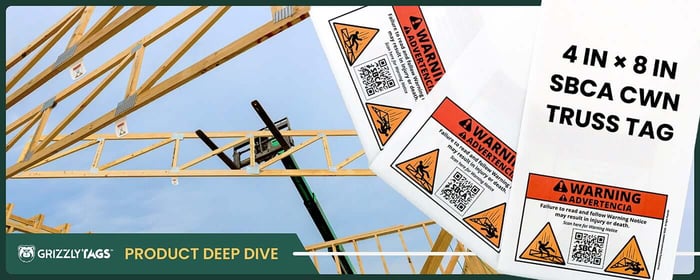
4 in × 8 in SBCA CWN Truss Tag: Built for Jobsite Safety
In today’s construction environment, safety communication can’t be an...
Built to Last: GrizzlyTags’ Durable Tagging Solutions
In demanding industrial environments, tags serve not only as identifiers but also as safeguards for...
Industrial Poly Labels for Harsh Outdoor Environments
In demanding industrial settings, labels don't get the luxury of sitting quietly on shelves....