
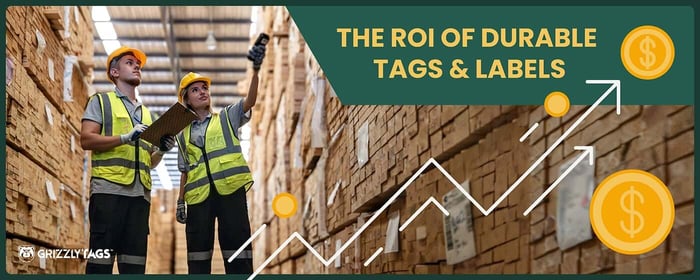
The ROI of Durable Tags & Labels: Why Investing in Quality Pays Off
Table of Contents
In industrial operations, there’s no shortage of big-ticket items competing for attention—equipment, labor, materials, logistics. Tags? Labels? They’re usually an afterthought.
But here’s the reality: when tags go missing, the effects ripple through the whole workflow. Production slows. Materials get misplaced. Crews waste time double-checking what should already be clear.
That’s where durable tagging and labeling solutions come in. When done right, they don’t simply identify your products—they strengthen your workflow, protect your data, and eliminate avoidable costs.
What Makes a Tag “Durable”?
Standard tags and labels are typically made of paper or thick cardstock. While they work great in controlled indoor environments, paper tags can quickly deteriorate when exposed to unusual or extreme environments.
Durable tags and labels are often made from a waterproof poly material that performs reliably when everything else isn’t. These materials can hold up through any combination of:
 Extreme Weather Extreme WeatherSun, rain, snow, and freezing temperatures |  Chemical & Moisture Chemical & MoistureOils, solvents, concrete residue, and water |  Abrasion & Rough Handling Abrasion & Rough Handling Heavy stacking, dragging, and vibration during transport |
In short, durable tags and labels don’t quit halfway through the job—a key factor in maximizing the ROI of durable tags over time.
Why Durable Tagging Matters
There is more to durable tagging and labeling than just ensuring they survive tough conditions, they also create consistency across your entire operations.
In demanding environments, materials often move through multiple hands and production stages. When you can count on your tags to perform reliably throughout the entire workflow, teams can move confidently from one step to the next. There’s no need to pause, verify, or correct. That level of predictability improves speed, reduces training friction, and keeps production aligned.
When that consistency slips, the cracks will show quickly. Cutting corners on tags might save a few cents upfront—but here’s what it actually costs:
- Materials that sit idle because no one can confidently identify them
- Crews that need to stop what they are doing to reprint tags instead of moving production forward
- Shipments arrive wrong—or worse, get rejected
- Compliance headaches that could have easily been avoided
- Frustrated customers and vendors who are now dealing with preventable mistakes
None of these will show up neatly on a purchase order, but they impact your margins all the same.
What should be a smooth process suddenly turns into a series of small interruptions that add up quickly in the form of increased labor and lost productivity. Investing in durable tags and labels eliminates that risk by keeping information intact and dependable at every stage. And when your identification stays consistent, your operation stays on track.
Choosing the Right Tagging Technology
Not all tagging methods will deliver the same results. The right choice depends on your environment, volume, and need for accuracy. Use the tabs below to compare the various tagging methods and to better understand the ROI of durable tags.

Manual / Handwritten Labeling
Pros
- Low upfront cost
- Simple to implement
- No equipment needed
Cons
- High error rate
- Inconsistent and slow
- Difficult to scale
Best Used For
It works best in low-volume, low-risk environments where flexibility matters more than speed or consistency. It is often used for:
- Temporary identification during short production runs
- One-off or highly variable items that don’t justify system setup
- Small operations without the need for standardized workflows
- Backup labeling when systems are offline
ROI Impact
While the upfront cost is minimal, the long-term ROI is typically low. Labor time adds up quickly, and inconsistent labeling increases the risk of errors, misidentification, and delays. As volume grows, these inefficiencies compound—turning what looks like a cost-saving option into a drain on productivity.

Preprinted Labels
Pros
- Clean, consistent appearance
- Moderate durability
- Easy to deploy
Cons
- Limited flexibility
- Waste when info changes
- Requires inventory
Best Used For
These labels are a strong fit for stable, repeatable workflows where product information doesn’t change often. Common applications include:
- Fixed SKUs with consistent labeling requirements
- Batch production with predictable outputs
- Environments where visual consistency is important
ROI Impact
Preprinted labels improve efficiency over manual methods by reducing errors and standardizing output. However, ROI is limited by their lack of adaptability. When product details change, excess inventory and reordering costs can eat into savings.

Print & Apply Systems
Pros
- Automated
- Highly accurate
- On-demand printing
- Supports variable data
Cons
- Higher upfront investment
- Requires setup/integration
Best Used For
This type of system delivers the most value in high-volume, fast-paced environments where accuracy and speed are critical. They excel in:
- Automated production lines where manual labeling creates bottlenecks
- Operations where the integration of variable data (job numbers, barcodes, customer info) improves tracking
- Workflows that require consistent, repeatable label placement
ROI Impact
Print & Apply systems typically deliver the fastest measurable ROI, making it one of the strongest drivers of the overall ROI of durable tags in high-volume operations. Gains in speed, consistency, and reduced labor and errors compound over time—making the initial investment pay for itself quickly.

RFID-Enabled Smart Tags & Labels
Pros
- Works with pre-existing systems
- Does not need line-of-sight scanning
- Accurate tracking
- Highly scalable
Cons
- Higher cost per tag
- Requires infrastructure
- Initial setup takes time and requires thorough testing.
Best Used For
RFID is best suited for complex, large-scale operations where visibility and tracking go beyond what barcodes can offer. Ideal applications include:
- Asset tracking across large facilities or multiple locations
- High-volume inventory environments requiring frequent and accurate counts
- Operations managing high-value or critical assets
- Businesses looking to automate data capture at scale
ROI Impact
RFID requires a higher upfront investment, but delivers strong long-term ROI through improved visibility, reduced manual scanning, and better inventory accuracy. The real value comes from the data, which enabes smarter decision making, fewer losses, and more efficient operations over time.
The right choice depends on your operation, but one thing is consistent: as complexity and volume increase, automation and durability deliver the strongest ROI.
Where Durable Tagging Delivers the Biggest ROI
Once the right tagging technology is in place, the next step is to utilize it where it makes the biggest impact and where the ROI of durable tags is most visible.
Start by identifying where labeling issues create delays, confusion, or rework. These are typically areas like:
- High-volume production lines where delays or relabeling can slow output
- Harsh or outdoor environments where standard labels fail early on
- Workflows with multiple handoffs between departments or teams
- Custom or variable products that require precise, job-specific identification
- Inventory-heavy operations where tracking accuracy impacts planning and fulfillment
- Compliance-driven processes where clear, consistent labeling is required
In these areas, durability isn’t just a nice-to-have—it directly impacts speed, accuracy, and labor efficiency. From there, consistency is key. Standardized placement, formatting, and materials allow teams to work faster and with more confidence.
The result is a compounding return: fewer slowdowns, fewer errors, and a process that performs consistently under pressure.
Getting More from Your Tags with Customization
Every operation has its own flow—how materials move, how teams interact, and what information matters most at each stage. Off-the-shelf labels don’t always account for that, but custom ones do.
Custom tags can be designed around your operation—not the other way around. That means the right material, the right size, and the right layout for how your team uses information.
Simple changes can make a big difference. Color coding can speed up sorting. Clear field layouts can reduce reading errors. Barcodes or QR codes can connect physical materials to digital systems without adding extra steps.
And when your tagging system is designed with intention, it becomes a reliable part of your process—not something your team has to work around.
Future-Proofing Operations
Growth is a good problem to have, but it brings complexity. More products, more locations, more moving parts. The last thing you want is a tagging system that can’t keep up.
Investing in durable tags that are compatible with evolving technologies, such as barcode systems, automation, and RFID, businesses can adapt without disruption. The foundation is already in place.
Meaningful ROI isn’t just immediate—it’s long-term. Investing in a reliable solution that continues to perform as your business evolves means fewer growing pains, fewer process overhauls, and a system that keeps your operation moving forward without missing a step.
The Bottom Line
At the end of the day, durable tagging isn’t just about materials—it’s about having a solution that actually fits your operation. That’s where GrizzlyTags comes in.
Choosing the right tagging partner matters just as much as selecting the right tag or label. At GrizzlyTags, we build full tagging solutions that hold up in real-world conditions. From rugged materials to fully customized solutions and scalable labeling technologies, everything we do is designed to keep your operation moving.
If you’re ready to get more out of your tagging system, give us a ROAR. We’ll help you identify opportunities to improve accuracy, efficiency, and ROI with the right solution.
Related Articles
Industrial Poly Labels for Harsh Outdoor Environments
In demanding industrial settings, labels don't get the luxury of sitting quietly on shelves....

How to Place an Order with GrizzlyTags
At GrizzlyTags, we know that getting the right tags, labels, and ribbons is...
Built to Last: GrizzlyTags’ Durable Tagging Solutions
In demanding industrial environments, tags serve not only as identifiers but also as safeguards for...