
Tags vs. Labels: Choosing the Right Product Identification Solution
Table of Contents
In the vast world of packaging and product identification, we often hear the terms "tags" and "labels" used interchangeably. While both are vital tools for branding, inventory tracking, compliance, and customer engagement, each has unique characteristics that make it more suitable for specific applications. Knowing when to use tags vs. labels—and how to choose the right design, materials, and adhesives—can help you enhance product presentation and increase efficiency.
Hanging With Tags
Tags do not have any adhesive and are secured to products through strings, ties, clips, or staples. You've likely seen them as hang tags on clothing, price tags in retail, or promotional inserts like coupons. Their non-permanent nature allows for easy removal, replacement, or repositioning. This makes them perfect for temporary messages, product identification, or branding that won't disrupt packaging.
Types of Materials
Tags can made from various materials, from coated or uncoated paper to durable synthetic films. The choice depends on factors such as indoor versus outdoor environments, intended use and durability needs, tear resistance, or print quality. Paper is the most cost-effective option and is ideal for indoor or short-term use while providing excellent printability with a wide range of finishes. However, it's less durable than synthetic materials and can tear or degrade when exposed to moisture, heat, or rough handling. Film substrates, such as polypropylene, polyester (PET), and vinyl, offer higher durability, water resistance, and tear strength than paper. These synthetic materials are ideal for harsh environments—such as industrial, medical, or outdoor applications—where moisture, abrasion, or chemicals are a concern.
Tag Features

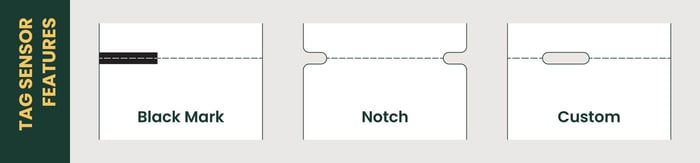
To allow it to hang, one of the most common features found in a tag is a hole, whether a single one or multiple. Different styles of holes can be utilized to work in specific settings, but the most common is a circular punch-out—often around 1/8", 1/4", or 3/8" in diameter—placed near one edge or corner of the tag. If you are using a printer to add information to your tag, something else to consider is what sensor feature your tag uses. Printers will use this feature to determine where one tag ends and the next begins, keeping the print properly aligned. This sensor feature could be something as simple as a printed black mark or worked into the shape of the tag as a notch.
When choosing between tags vs. labels, tags give a lot of flexibility, but when you need something that will STICK, then labels are the way to go!
Sticking With Labels
Labels have adhesive backings that allow them to stick directly to surfaces like containers, packaging, or equipment. They serve multiple purposes—from branding and safety warnings to barcode tracking and nutritional information.
Types of Coatings
The choice of material and adhesive greatly impacts label performance. As mentioned before, paper is cost-effective and great for indoor applications, while synthetic films excel in outdoor settings requiring water, chemical, or UV resistance. A varnish—a thin layer of protective coating— or UV coating can be added to help guard against smudging or abrasion. UV coatings are cured under ultraviolet light, offer a more durable surface than a traditional varnish, and are resistant to scratches, chemicals, and fading. Adhesive options can vary to suit different conditions. Their chemical makeup—typically involving high-tack rubber-based or acrylic formulas—ensures strong adhesion and lasting bonds to a variety of surfaces. Acrylic-based adhesives tend to perform better in high temperatures and UV exposure, while rubber-based adhesives offer stronger tack on rough or low-energy surfaces like cardboard.
Types of Adhesive
Permanent adhesives are formulated to create a strong, lasting bond. Once applied, these labels are difficult to remove without damaging the surface or leaving residue. They're ideal for product labeling, compliance applications, and environments where the label must remain affixed for the life of the product. On the other hand, removable adhesives are made to peel off cleanly without leaving residue. They are generally pressure-sensitive and work best on smooth, clean surfaces. However, removability depends on the surface and how long the label has been in place—over time, even removable adhesives can form a semi-permanent bond. Repositionable adhesives bridge the gap between permanent and removable. They allow for initial adjustment during application—useful in automated labeling lines or when precise placement is crucial—while gradually increasing bond strength over time.
Label Features

Labels are typically available in two main styles. The most common is the die-cut label, which features rounded corners with a clearly visible liner that separates each label. The other style may resemble a tag at first glance—appearing liner-less—but includes a back-slit on the liner that allows it to be peeled away from the label. This option is excellent for larger labels that need to be placed precisely, as the back-slit lets you expose only a small section of adhesive at first and then remove the rest of the liner to fully apply the label only after it has been properly placed.
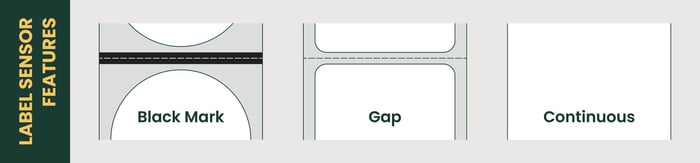
For die-cut labels, printers can use the gap between each label as a sensor, but if your die-cut shape is unique then an added black mark will give you a more consistent calibration. Circles, while a common label shape, also benefit from a black mark sensor as not all printers have a positional sensor that can reach the middle of the circle where the gap is the smallest.
Tear It Away With Perforations
An essential but often overlooked element of both tags and labels are perforations. These "perfs" are a series of small cuts in the material that allow easy tearing. Most of the time, perfs separate individual tags or labels on a roll or stack. However, internal perfs are also used for a wide range of applications, such as detachable coupons, stubs for tracking, tear-off instructions, or multi-part tags. Perf placement and strength can be customized depending on the tag or label size, substrate, and handling requirements.
Don't want a perforation at all? That's fine! Most printers have a cutter option to cut the media away from the roll after printing. This option is used for continuous media—which typically has no sensor feature—and is ideal when the length of the tag or label varies depending on what is printed.

Finishing Things Up
After printing, tags and labels can be finished in different formats depending on storage, transportation, or application needs. Rolls are popular for automated or semi-automated label applicators and are ideal for efficient storage and quick dispensing, especially in high-volume settings. Fanfolded finishing—a folded zig-zag pattern with a perforation between each unit—is perfect for continuous-feed printers or compact storage environments like logistics and warehousing. Sheeted media works well for manual application, small batches, or office printing, especially when precision hand placement or custom packaging inserts are required.

Embrace the Distinctions
Tags and labels share many similarities, so it's completely understandable when the terms get mixed up, but knowing their differences ensures your products perform reliably in the field. The key is to think about what you need your tag or label to do before ordering. Would you benefit more from a tag's removability and flexibility or a label's durability and compliance? If you plan to print on them, check whether your printer has specific requirements for media sensing, size, or material.
Not sure which one is right for your application? Give us a ROAR! We are happy to help you navigate the various options to tailor a solution that meets your operational goals. Whether it's tags vs. labels or any other printing need, we've got your back!
Related Articles

How to Place an Order with GrizzlyTags
At GrizzlyTags, we know that getting the right tags, labels, and ribbons is...
Thermal Transfer Ribbons: A Complete Guide
In demanding industrial environments, things are always in motion. Amidst the chaos of day-to-day...
The ROI of Durable Tags & Labels: Why Investing in Quality Pays Off
In industrial operations, there’s no shortage of big-ticket items competing for...